


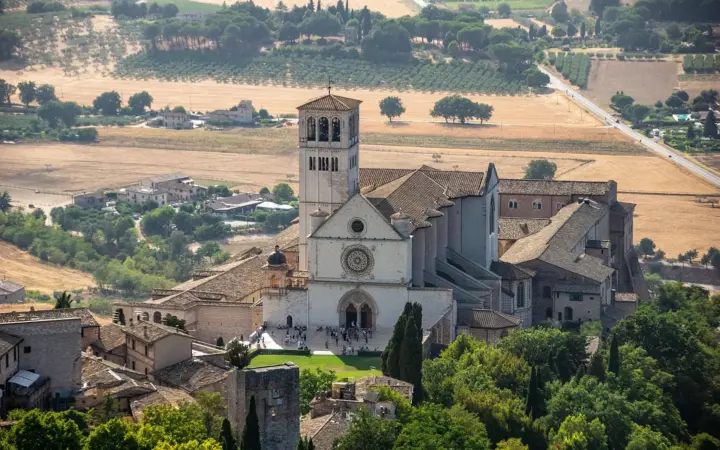
Umbria is the only region of peninsular Italy with no coast, lying between Tuscany, Lazio and Marche. Its wooded hills, olive groves and medieval towns have earned it the name “the green heart of Italy”.
Why visit Umbria
For spirituality, art and slow travel. Umbria offers some of the finest medieval towns in Italy, the great pilgrimage centre of Assisi and a rich countryside cuisine, at a gentler pace than its famous neighbour Tuscany.
Top places in Umbria
Assisi
The town of St Francis, with the frescoed Basilica of St Francis, a UNESCO World Heritage Site, and pink-stone lanes on the slopes of Mount Subasio.
Perugia
The lively regional capital, with a grand main street, the Fontana Maggiore, a national gallery and the famous chocolate festival.
Orvieto
A town on a cliff of volcanic rock, crowned by one of the most beautiful cathedrals in Italy.
Spoleto and Gubbio
Spoleto with its Roman remains and summer arts festival; Gubbio, a perfectly preserved medieval town of grey stone.
Lake Trasimeno and the Marmore Falls
The largest lake in central Italy and one of the highest man-made waterfalls in Europe.
Best time to visit Umbria
Spring and early autumn are ideal for walking towns and countryside. Autumn brings truffles, new olive oil and food festivals. Summer is warm and busy with festivals.
Getting to and around Umbria
Perugia airport has a few flights; most visitors arrive via Rome or Florence. Trains link Perugia, Assisi, Spoleto and Orvieto, but a car is best for small villages.
What to eat in Umbria
Black truffle, cured meats from Norcia, lentils from Castelluccio, strangozzi pasta, extra-virgin olive oil and Sagrantino di Montefalco red wine.
Umbria FAQ
How many days do I need in Umbria?
Three or four days for Assisi, Perugia and Orvieto; a week to add smaller towns and the lake.
Can I visit Assisi by train?
Yes: Assisi station is in the plain below the town, linked to the centre by a frequent bus.