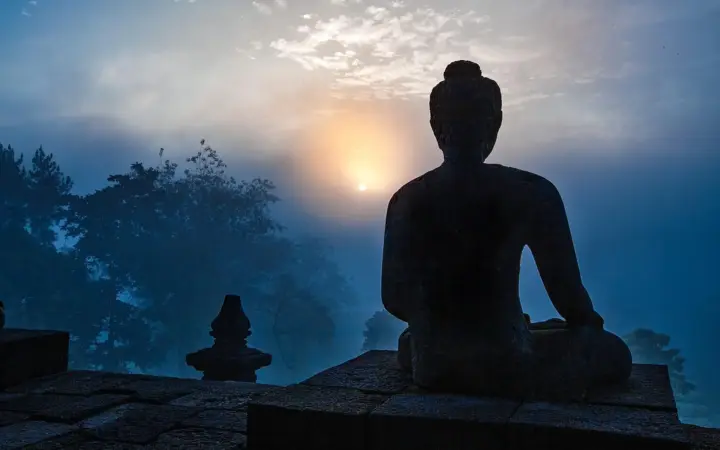


Borobudur is the largest Buddhist temple in the world: a stepped stone mountain built in the 8th and 9th centuries in the Kedu Plain of Central Java, ringed by volcanoes. It has been a UNESCO World Heritage Site since 1991 and lies in the village of Borobudur, about 40 km north-west of Yogyakarta.
What to see
The reliefs
Climbing clockwise, the galleries of the square terraces show 2,672 relief panels: scenes of daily life, the life of the Buddha and the pilgrim Sudhana’s search for wisdom – a path from the world of desire towards enlightenment.
The stupas
The three round terraces at the top carry 72 bell-shaped stupas, each with a Buddha statue inside, around one great central stupa. In all, the temple holds 504 Buddha statues.
The museums and the park
The park includes the Karmawibhangga Museum, with the hidden reliefs of the temple’s buried base, and the Samudra Raksa Museum, with a replica of a ship like those shown on the walls.
Climbing the monument
- Since 2023 visitors on the temple structure are limited each day: climbing needs a special timed ticket, booked in advance, and is done in small groups with a local guide.
- Climbers wear upanat, woven sandals handed out at the entrance, to protect the stones.
- With the regular ticket you visit the park and see the temple from its base and gardens.
Tips
- Sunrise: watch it from Punthuk Setumbu, a hill nearby, with the temple rising out of the mist; the Borobudur sunrise and Prambanan tour goes there and includes the climb ticket.
- Bring a hat and water: the upper terraces have no shade.
- Pair it with Prambanan, the great Hindu temple on the other side of Yogyakarta.
Where to stay? See the 4 best hotels near Borobudur.