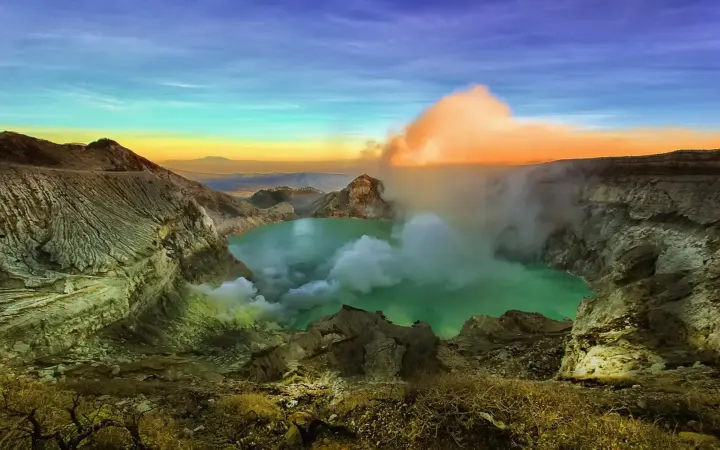


Ijen is a volcano on the eastern tip of Java whose crater holds a vast turquoise lake – the largest highly acidic crater lake in the world – and, on dark nights, the famous blue fire. It is the reason most travellers come to Banyuwangi, and part of the Ijen UNESCO Global Geopark.
What to see
The blue fire
The blue flames are sulphurous gases that ignite as they escape from the rocks by the lake. They can only be seen in complete darkness, which is why hikes start in the middle of the night. They are a natural phenomenon and never guaranteed.
The crater lake
At sunrise the milky turquoise lake appears below the crater rim, steaming between yellow sulphur deposits and grey cliffs.
The sulphur miners
Local miners still carry heavy baskets of sulphur up from the crater by hand – a hard job you will see on the trail. Ask before taking photos.
The hike
- The trail starts at Paltuding, the basecamp, and climbs about 3 km with roughly 500 m of ascent: 1.5–2 hours up, steady but not technical.
- The descent into the crater is allowed only when the gas levels are safe, and it is steep: it is not for people with asthma, heart problems or a fear of heights.
- A gas mask and a headlamp are essential; tours provide both.
Tips
- Get a health certificate before the climb: it is required, and most tours arrange it.
- Remember the first Friday: the trail is closed on the first Friday of every month.
- It is cold at the top before dawn: bring a warm jacket, long trousers, gloves and good shoes.
- The easiest way is a night tour with pickup: see the Ijen sunrise tour from Banyuwangi.
Where to sleep the night before? See the 5 best hotels in Banyuwangi.